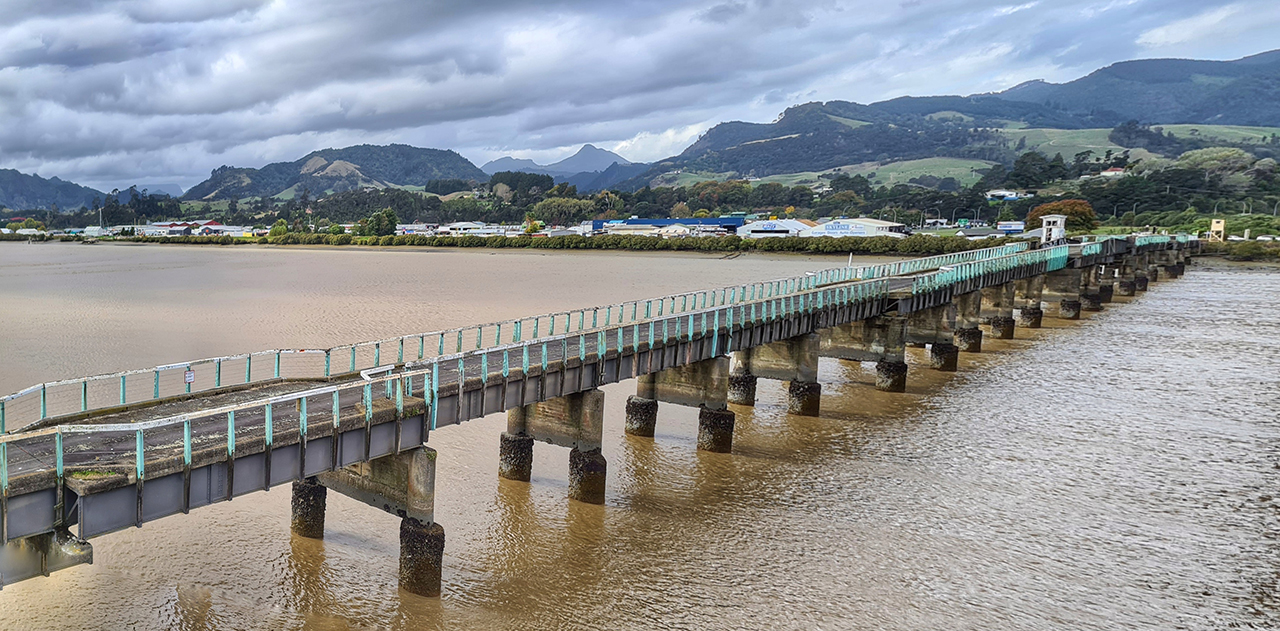
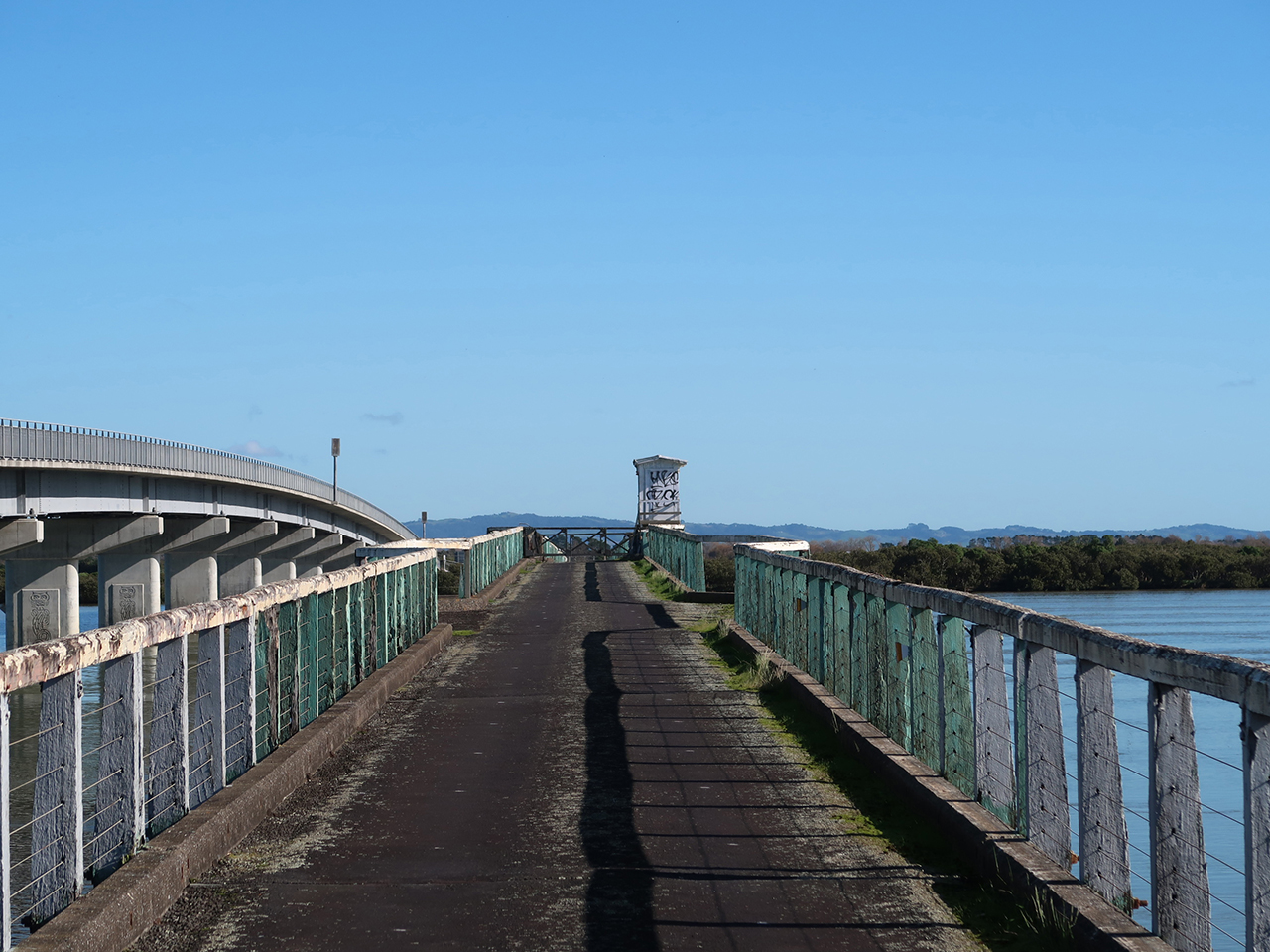
Kopu Bridge is a rare surviving example of a swing span bridge in New Zealand, which marks the transition from river transport in the region to the domination of roads. Constructed in 1926-1928, the steel and reinforced concrete structure crosses the Waihou estuary near the town of Thames. It was erected soon after the Main Highways Board had been created by central government, taking over responsibilities for trunk roads from local authorities as a way of improving rural productivity. Both central and local government bodies funded the new structure, which connected Thames with the low-lying Hauraki Plains. The plains had been extensively drained and converted to dairy farming following an Act of Parliament in 1908. The bridge enabled road traffic to cross to and from Thames, while still allowing boats to transport butter exports and other goods from further upstream. The project to build the bridge was one of the largest undertaken at this time, with planning beginning in 1922. The structure was opened in May 1928 by the Prime Minister, Gordon Coates (1878-1943), who was leader of the farmer-orientated Reform Party and responsible for creating the Highways Board as a previous Minister of Public Works.
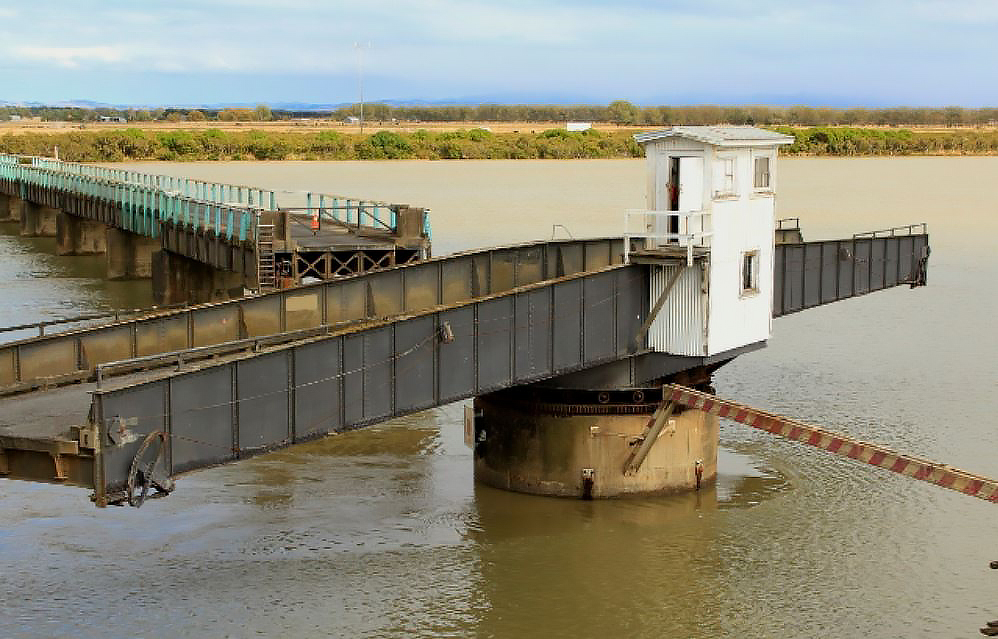
The bridge is an extensive 463 metre-long structure, which is mostly a single lane wide. It was designed by J. E. L. Cull, who had been the first design engineer employed by the Department of Public Works. The structure consists of 23 steel spans sitting on reinforced concrete piers. It has a central swinging span 42.7 m long, which turns on a central pier, providing boats with a clear width of 15.8 m between the fenders. The structure was technologically advanced, particularly in its use of deep piles to counteract a soft river bottom and strong tidal currents. A bridge master operated the electric swing mechanism, and was housed in a central cabin. Although a system of coloured lights was used to inform shipping about the opening of the swing span, early difficulties in boats adapting is evident from accidents in 1927 and 1928, when both the 'Tuhoe' and 'Taniwha' crashed into the bridge. As river transport declined, the bridge became more important for providing passage to the growing amount of long-distance road traffic between Auckland and the Coromandel peninsula. In the early 1990s it became the most heavily used single-lane road bridge in New Zealand, seeing 4,200 vehicles per day.
Kopu bridge is nationally significant as the only surviving road bridge of swing span type in the country. It makes a valuable contribution to the history of both motorised road transport and shipping, and is particularly significant for demonstrating early central government involvement in the development of highways. It marks the last stages in the history of major river transport on the Waihou, used by both Maori and Captain Cook. The bridge is important as a substantial technological achievement, occurring as New Zealand placed a greater emphasis on large-scale engineering projects in the 1920s. It demonstrates the political prestige placed in such works, being particularly linked with Gordon Coates and the development of the rural economy. The bridge was one of the most significant public projects carried out in the region, and is important for its connections with the expansion of farming and butter production. The bridge has had a long association with Thames and can be linked to the town's move away from its reliance on the mining industry. It is a distinctive part of the local landscape, and has educational value as a well-known and well-used historic structure on a major holiday route.